
What we hope our children bring home from camp.
In conversation with Dr Arne Rubinstein on rites of passage in schools
By Paula Conroy | The Frequency
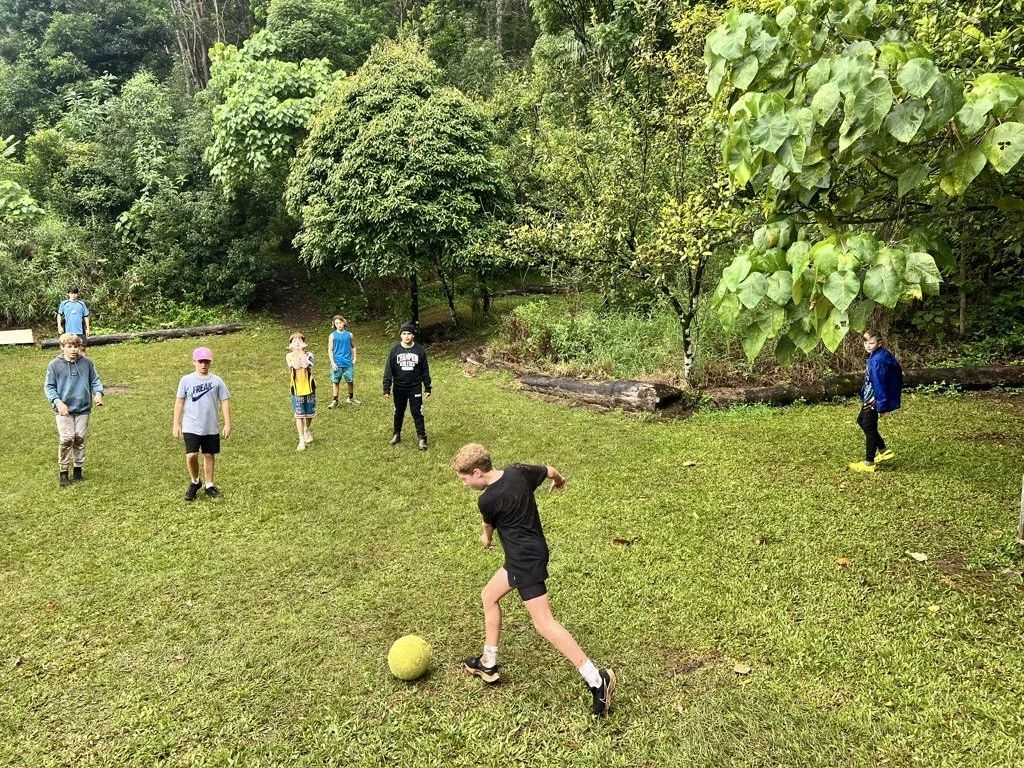
When we send our children away on school camp, what are we really hoping they will bring home?
Beneath the practical concerns about whether they will sleep, make friends and remember their belongings, many of us are hoping for something harder to put into words…
We want them to discover that they can meet a challenge without us beside them… that they have something valuable to offer a group… and that when things become difficult, they can ask for support and find a way through.
As a mother of two, I have stood on the parent side of that departure… My children have attended camps across two different schools, and neither school used the rites of passage framework or included the added ingredients I know can give these experiences greater depth.
Alongside the feelings that come with sending my children away, I felt an intense sadness at the opportunity being missed… I could see the potential for the camp to become a significant moment in their growing up, and for the adults seeing them off to be part of that transition.
A camp can be full of adventure, laughter and worthwhile activities. Those things matter…
Yet I find myself thinking about what else could happen within an experience a school is already investing so much care and effort in creating.
What if children were helped to recognise the courage they had shown, understand how they had supported one another, and bring those discoveries back into their everyday relationships?
What if parents were invited to share their own hopes and uncertainty, so that the experience strengthened the community around the children as well?
Through my conversations and work with Dr Arne Rubinstein, I have come to see school camps within this much larger journey… Schools accompany children through changing friendships, emerging independence and the uncertainty of adolescence.
Arne brings more than thirty years of experience working with young people and families as a doctor, counsellor, mentor and facilitator. The author of The Making of Men and founder of the Rites of Passage Institute, he was named Australian Father of the Year in 2025. His work offers schools a practical way to think about the human transition unfolding alongside a child's education.
Although his book focuses on boys, the wider invitation matters for all our children: to be supported as their relationships change, to discover what they can contribute, and to have their growing maturity recognised by the people around them. That requires attention to each young person's circumstances, rather than an expectation that everybody will grow in the same way or at the same pace.
Preparing the ground long before Year 9
One of the most useful ideas in The Making of Men appears well before the chapters on camps and rites of passage. Arne explains that the relationships we establish with children when they are young influence our ability to stay connected with them when they become teenagers.
Preparation begins in the ordinary moments:
whether adults listen
how they respond to mistakes
whether their behaviour reflects the values they ask children to live by
For schools, I see this as preparing the ground… If we hope that young people will speak honestly, listen respectfully and support one another during a significant adolescent experience, they need opportunities to practise those things beforehand.
A circle at camp will feel very different to a child who has already experienced being heard without ridicule. Taking responsibility will feel different to a student who has been trusted with meaningful contributions over several years.
In the younger years, that might mean a simple classroom practice of:
taking turns to speak
recognising an act of kindness
caring for something that belongs to everyone
Later, it could involve:
learning to repair a friendship
welcoming a new student
reflecting on a challenge without immediately measuring oneself against someone else
Year 9, or Grade 9 in South Africa, can provide a meaningful focal point within this journey. It should sit within a longer progression, responsive to the actual readiness of the young people involved.
Arne makes clear in his book that timing varies between individuals. A school year gives us a place to organise an experience; it cannot tell us everything about a child's development.
Adding the ingredients that give a camp deeper meaning
Many schools already have much of what they need:
committed teachers
outdoor education expertise
pastoral care
opportunities for students to spend time together beyond the classroom
We think of the rites of passage framework as adding a few essential ingredients to a cake that is already being made.
Arne points towards the three stages:
separation
transition
return
Within the transition, he emphasises story, challenge, vision and honouring. Reflection on the person a young individual hopes to become gives direction to the experience, while the return connects it to the life waiting at home.
A camp already provides physical separation from familiar routines. We can deepen its meaning by helping students consider what is changing in their lives and what they would like to explore. This might be:
a growing willingness to ask for help
take responsibility
step beyond an established role within their friendship group
The practice of circle gives a group a way to begin changing how its members relate to one another. Students are invited to speak from their own experience and to listen actively: to stay with what someone is saying, allow them to finish, listening to understand, and not to respond.
Vulnerable storytelling belongs within that care. A teacher might share an age-appropriate story of uncertainty, a mistake or a time they needed help, without turning it into a lecture or asking children to carry adult concerns.
Students can be invited to share at a depth they choose, with the freedom to pass. Trust develops through the way those stories are received. Clear agreements about respect, privacy and when an adult must seek help to protect someone give that trust a sound foundation.
Without opportunities to notice and practise a different response, familiar patterns of interruption, withdrawal, ridicule or control can simply continue. The adults are part of this learning too; our example gives weight to what we ask of the children.
An age-appropriate and culturally appropriate challenge can take a young person to the edge of what feels familiar and manageable. With skilled adults attending to safety and offering appropriate support, there can be room to stay with that uncertainty, try, adjust and discover a capacity that surprises them.
The distinction between discomfort and danger matters. The aim is a supported encounter with uncertainty, with physical and emotional safety actively maintained. Challenge should respond to the individual child, including disability, neurodivergence, previous experiences and cultural context.
Consider a group hike. Alongside the physical effort, a student might discover that they can navigate an unfamiliar route, remain patient when plans change, or encourage someone who is struggling.
Honouring asks us to name what we have actually seen. Perhaps a student noticed someone falling behind, remained patient when the group was frustrated, or admitted a mistake and helped put it right.
When these qualities are recognised specifically, young people receive a fuller picture of what they bring to a community.
Being seen can open a different possibility
In The Making of Men, Arne tells a camp story about a withdrawn boy who initially declines to speak in the circle. A facilitator notices his interest in the campfire and gives him a meaningful role caring for it. As the account unfolds, the boy becomes more engaged, and later volunteers to help at another camp.
What might become possible when we notice a young person's interest and give it somewhere useful to belong?
A child can become very familiar with the role they occupy at school: the quiet one, the difficult one, the capable one who never needs help. A well-held experience can offer space to be encountered differently.
The potential reaches beyond individual confidence into the everyday culture of the year group.
What schools have already put into practice
A helpful example comes from St Hilda's Anglican School for Girls in Perth. Writing in 2021, then-principal Fiona Johnston described a year-long Year 9 rites of passage programme developed with Arne, with regular curriculum sessions accompanying a twelve-day Wandering Spirit retreat at the school's Yeagarup campus.
Pymble Ladies' College provides a different example of involving the wider community. In April 2021, Arne moderated its Respect Matters public forum on consent education which I attended with him, with experts supporting parents and carers to have important conversations with their children.
For a school considering this approach, meaningful questions include whether students feel more connected, whether they can identify trusted adults, and whether commitments made during an experience are still being supported afterwards.
Parents are part of the transition too
When I think back to sending my own children away, I think about the conversations the parents could have had with one another… We were each accompanying a child with a different history, different worries and a different readiness for being away from home.
Before a camp, a facilitated parent circle could invite those conversations. One parent might be hoping their child will find a friend; another, that their child will trust their own judgement. Someone may be anxious about letting go, while another is navigating a milestone they have barely had time to recognise.
Parents need the same respect for choice and privacy as children. Nobody should be expected to disclose a private family difficulty or speak on behalf of a child's inner life.
The opportunity is to share our own experience of accompanying them: what we are learning, what feels difficult, and how we might support their growing independence.
This is relevant across families. Mothers, fathers, grandparents, carers and other trusted adults all have a place in the community around a child. A school's approach needs to make room for different family structures and circumstances, so that participation never depends upon having one particular kind of family.
At the return, a welcome-home gathering can give students an opportunity to share what they choose about their experience and allow families to recognise the effort and growth they have witnessed.
A ceremony does not make a fourteen-year-old a finished adult. It can mark a step towards maturity and a shared commitment to support what comes next.
A South African expression rooted in its own community
For South African schools, I believe this conversation needs to begin with listening… Rites of passage already carry profound meaning in many communities, with distinct histories, custodians and living traditions. An educational framework must be approached with respect for that knowledge and for the people to whom particular practices belong.
The invitation I am making is to explore a secular, practical framework for supporting transition, expressed through the school's own community and developed in conversation with students, parents, teachers and staff. There is no need to reproduce someone else's tradition to create meaningful opportunities for reflection, responsibility and recognition within school life.
Some additions may be simple:
a parent circle before departure
more deliberate reflection after a challenge
specific recognition of each student's contribution
a thoughtful welcome home
If this speaks to hopes you hold for your own school community… I would love to hear from you. Feel free to reach out anytime, or explore what we do if you're curious to learn more.
What I hope for my children is that, when they meet something difficult, they have lived experiences to draw on…
That they can remember:
a time they surprised themselves
a person who listened
a group that helped them find their way
With a more intentional process around those moments, a school can help its community recognise and support the transition together. Then what comes home from camp can include a deeper trust in oneself, a different understanding of one another, and a stronger sense of belonging to the people with whom the journey continues.
With love,
P xx