
Rites of Passage and the Golden Ink of Connection
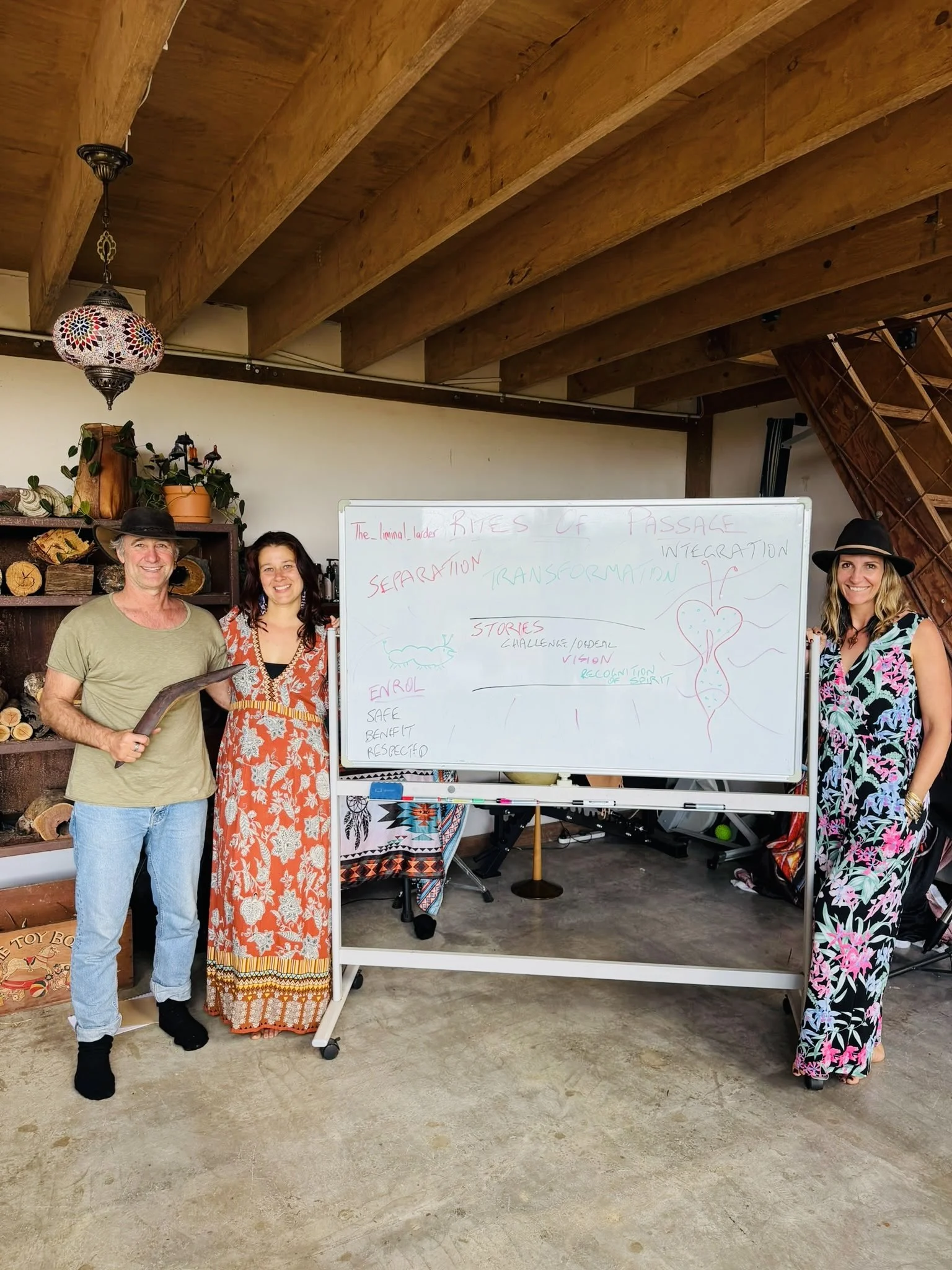
I have just returned from facilitating a Rites of Passage Leadership Training alongside Dr Arne Rubinstein and Rebekah Volgin at Yarrakoora, home of the Rites of Passage Institute in the Byron Bay hinterland.
We were joined by 36 people, ranging in age from 26 to 62. A diverse group of people from different cultures, different beliefs, different life experiences and different reasons for being there. By the end of Sunday… we felt no difference from each other :-)
I left deeply moved… moved by what they were willing to meet in themselves….. moved by the possibilities they could see for their families, schools, workplaces and communities.
Whatever our background, we will all encounter moments when life asks us to move beyond who we have been. These thresholds can look like:
Adolescence
Leaving school
Entering a relationship
Becoming a parent
Separating
Losing someone we love
Watching our children leave home
Sometimes we recognise it immediately. Sometimes we only understand what is changing once the familiar no longer fits. Life will carry us into these transitions whether or not we feel ready.
The questions are… How do we meet them? Who stands beside us? Do we have the support to let this become a passage into greater maturity and awareness?
When life changes but our patterns remain
A child entering adolescence needs to:
develop responsibility
discover their gifts
experience themselves as someone with something meaningful to contribute
The adults around them are also being asked to change. Our relationship with a young person needs to grow as they grow, making space for independence while still offering guidance, care and boundaries.
Likewise, when children leave home, there is a passage for the parent. We are learning how to set them free. How to relate differently. How to discover who we are within a changing family. There can be grief in this, alongside pride and possibility.
Yet many of us have had little support in understanding these passages. We can find ourselves carrying old behaviours and expectations into a life that now needs something different. We may try to hold a relationship in its old shape. Or respond to a new responsibility with patterns that once protected us, but now stand in our way.
The rites of passage framework gives us a practical way to notice this, and work with it. (If this resonates, you might also enjoy our post on the space between who you were and who you are becoming.)
A framework we can bring into everyday life
In his 1909 book Les rites de passage, anthropologist Arnold van Gennep described a three-part pattern: separation, transition and incorporation.
We speak of it as:
separation — stepping away from the familiar
transition — entering a space in which change can be met
integration — returning to everyday life with a different understanding of ourselves
Within the approach taught by Dr Arne Rubinstein, storytelling, meaningful challenge, vision and honouring help give this process shape. We make room to:
speak and be deeply heard
encounter a challenge with support
recognise what we are ready to leave behind
imagine how we want to live from here
The framework we teach is secular and practical. It can be learnt and adapted to any age, circumstance or need. This is the beauty of this formula and its inclusive nature. And… it is important to also note that living cultural traditions belong to the communities who hold them. Our invitation is simply this: consider how a practical framework might support your own context, with locally led expression and respect for what is already present.
By the end of the training, each of the participants had a vision, and practical steps for bringing the work into their own life or community. Some arrived without knowing what had drawn them there. They left with a much clearer sense of their direction.
The adults our young people need
One concern that surfaced among some of the parents and educators that were present, was the world our children are growing up in.
Gaming. Social media. Artificial intelligence. Access to an almost limitless online world.
Some adults feel unsure how to respond. Some feel helpless, or powerless, in the face of something moving faster than they can understand. As a parent myself to two tweens, I recognise and resonate this concern. I feel at times the helplessness and powerlessness of the bulging online world… which brings me back to a question that feels increasingly important: what is being asked of us, as adults?
I believe that alongside the decisions we make about technology and boundaries, there is deeper work to be done:
developing our own capacity to listen
remaining present when something is uncomfortable
taking responsibility for our reactions
guiding without needing to control every outcome
This is part of what I mean by healthy, mature, initiated adulthood. We continue meeting our own unfinished places so that we can be more available to the people who need us. Our young people need adults who are willing to keep growing alongside them. And communities in which they can be seen, valued and supported as they discover who they are becoming.
The golden ink of connection
I sometimes imagine the more harmful currents of the online world as black ink dropped into water, spreading through our attention, our relationships, the way we understand ourselves. This is not a judgement on everything technology offers. It's an image for the overwhelm many of us feel. When I sit with this image, I also see the possibility of what I call the golden ink of connection.
We cultivate it when we:
sit in circle and make room for a story to be told, without immediately correcting or fixing it
listen deeply enough to discover something we had not understood
support one another through challenge
recognise a person's gifts in a way that helps them recognise those gifts in themselves
Connection gives us somewhere to return to while we navigate a complicated world. It helps us meet that world with more discernment, more responsibility, and a stronger sense that we have a part to play in shaping it.
What we bring home matters
A person's passage matters to their community.
What we discover about ourselves takes on new meaning when it changes:
how we parent
how we lead
how we listen
how we respond when a relationship becomes difficult
Integration is the ongoing practice of bringing those discoveries home, where the familiar patterns will inevitably meet us again. That is what moved me about these 36 people. Alongside the wish to understand themselves more deeply was a desire to contribute. A desire to become more capable of serving their communities. A willingness to recognise the ways they might be standing in their own way.
I feel immense gratitude for Arne, Rebekah and everyone who met this experience with an open heart.
My hope is that supported rites of passage become a familiar part of modern life. Our children deserve adults who are willing to meet that invitation, and a future we are willing to help shape through the way we live now.
Perhaps there is a transition unfolding in your own life. Or in the life of someone you love. What might become possible if it were met with more intention, support and connection?
If this reflection speaks to you, I would love to hear what it brings up. Feel free to reach out anytime, or have a look at what we do if you're curious to learn more.
With love,
P xx