
What a room full of blindfolded mothers taught me about safety, anxiety and the teen years.
There's an exercise I run in my mothers' circles, on camps and in The Frequency circles, and it never fails to land.
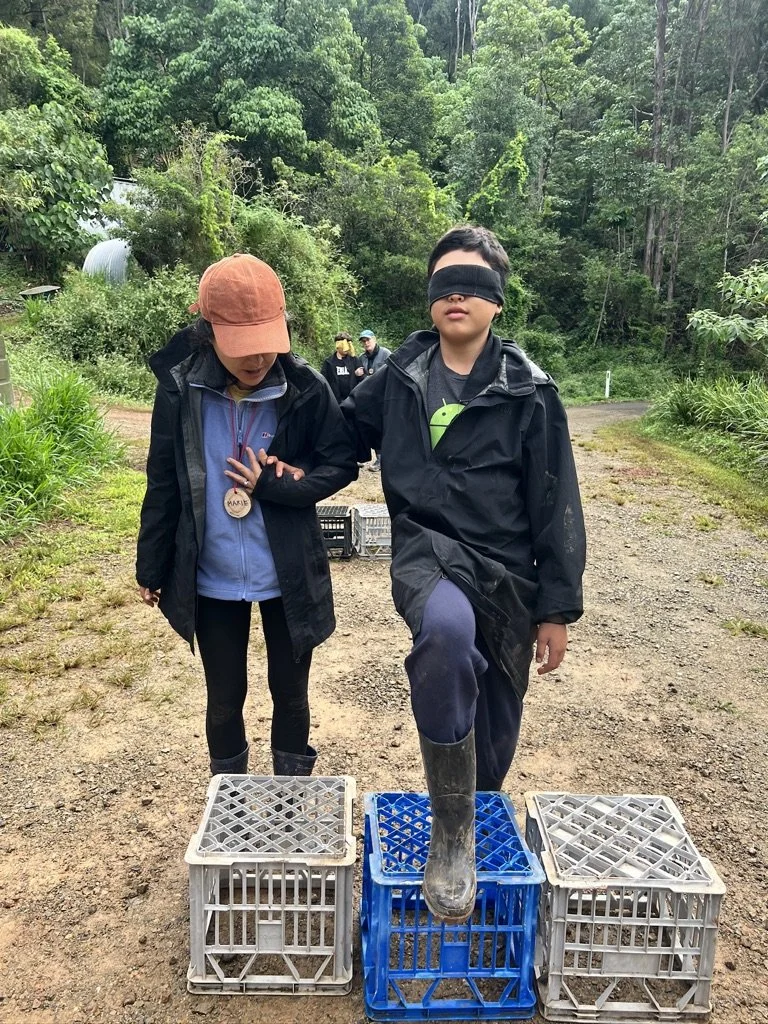
When everyone has arrived and settled, I ask the women to stand. I hand each of them a blindfold. Once they're covered, I turn them around on the spot, three, four, five times, until they've lost all sense of direction. Then I give one simple instruction: Find the closest wall.
What happens in the dark
It always amazes me at how quickly the feeling in the room changes… confident, capable women slow right down. Their movements become cautious and tentative. Most of them end up on their hands and knees, crawling slowly in a direction they can't be sure of but are desperately seeking to sense.
Then I begin to offer prompts. A little more to the left. The wall is closer than you think. Keep going. As the information comes, I can see their confidence grow. And when they reach the wall, there's visible relief… Shoulders drop….. Breath returns.. and often they laugh at the experience they just had.
When we come back into circle and the blindfolds come off, the women always share the same things. They felt anxious, vulnerable, uncertain, scared, apprehensive about not knowing which way to go. And When they finally found the wall, they felt a great sense of relief.
This is what it feels like to be a child without boundaries
This is the metaphor I invite every mother to carry home.
A child without clear boundaries is living in that blindfolded room. Scared, vulnerable, uncertain, a little awash…. often not even conscious of the fact that this is how they are feeling. They just feel it, and it comes out sideways: as overwhelm, contraction, defiance, acting out.
Healthy boundaries are the wall. They are the container that tells a young person: you are held, you know where you are, you can relax.
Safe enough to be unsafe
Witnessing this excercise time and time again has given me so much more confidence to instill boundaries, especially as my own children step into their teens. I recognise and can see in the mothers, that it is within a solid container that young people feel safe enough to become unsafe. Much like us. To take risks. To test the edges. To push against the wall and discover it holds. That testing is healthy; it's how they grow.
But when there is no container, the unsafety doesn't become adventure. It becomes anxiety.
Boundaries, not barriers
I want to be clear here, because I've got this wrong at times. A boundary is not a barrier… and I have sometimes (in hindsight!) recognised that my perceived ‘strong boundary’ has in fact created a barrier. A barrier can shut our children out of their world because we're afraid of something we perhaps don’t understand… A boundary holds them while we walk alongside them in it… stay connected to them, and have the opportunity to guide them.
With my son and his beloved Minecraft, we don't have a wall of no. We have an agreement, reached together, about when and how long he plays, and I take an interest in what he's building while he's there. The boundary holds, and so does the connection.
That's the work of the parent and the trusted adult in the teen years: to be the clear, warm wall in a world that can feel very dark and very spinning to a young person.
Learning to hold the container
In traditional cultures, Rites of Passage gave young people exactly this: a clear container, held by elders who knew the way, so they could step bravely into the unknown and come out the other side changed.
That is what we practise in the Rites of Passage Leadership Training with Dr Arne Rubinstein, in South Africa on 5 to 7 March 2027 at Cherry Glamping in Elgin. Over three embodied, residential days, you'll learn how to hold that container for your own children, their friends and the young people in your community, with clarity and with connection.
Find out more and book your place
And if you'd love your child's school to bring this in, just reply to this email and I'll send you what you need to start the conversation.
With love,
Paula